Autonomous Physical AI & Humanoid Robotics: Zero-Shot Sim2Real Deployment in Automotive Gigafactories
"How physical AI foundation models and synthetic physics simulation enable zero-shot transfer for bipedal humanoid robots on automotive manufacturing lines."
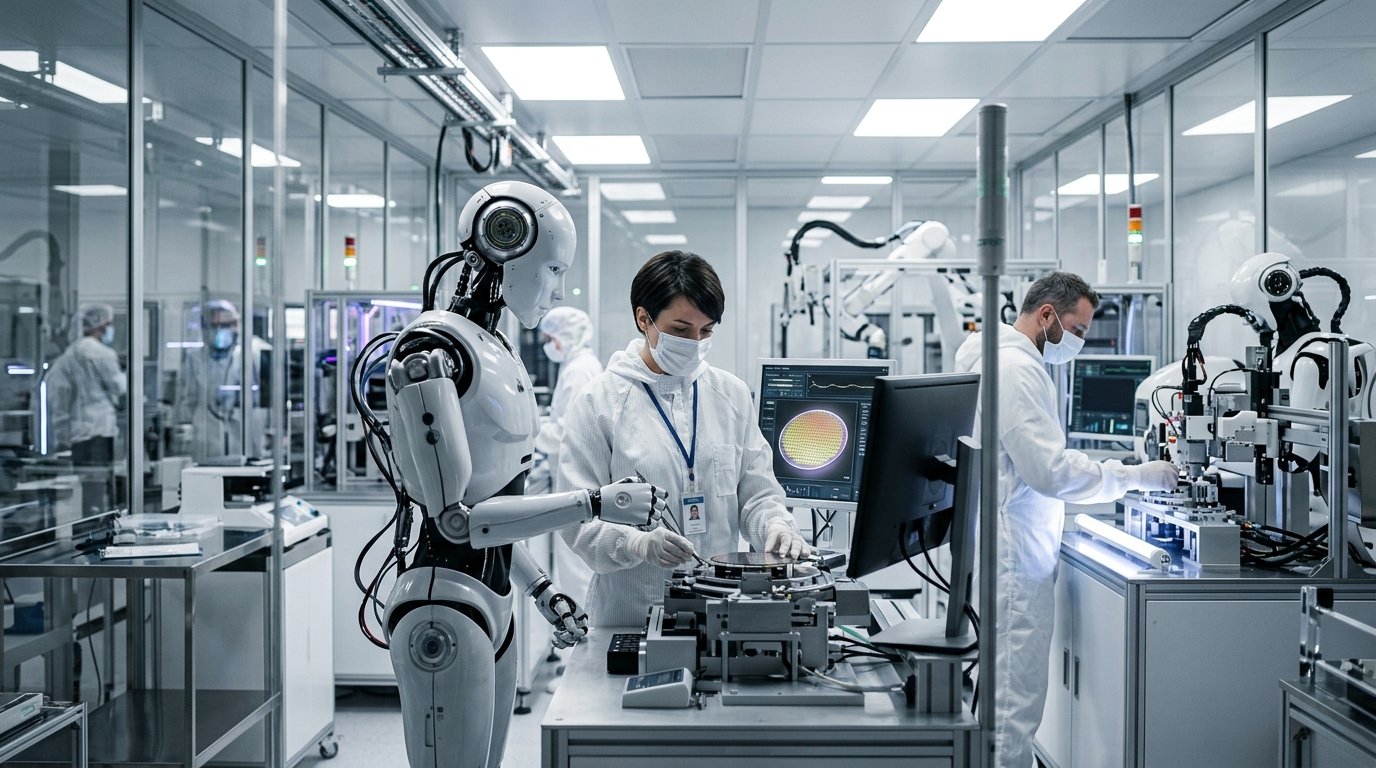
The Dawn of Production Physical AI
For decades, industrial robotics consisted of bolted-down 6-axis arms executing rigid, deterministic coordinates with zero adaptability. In 2026, the convergence of multimodal vision-language-action (VLA) foundation models and photorealistic GPU physics simulations has enabled true Physical AI: general-purpose bipedal humanoid robots operating directly alongside human assembly line workers.
Deployments across major tier-1 automotive manufacturing plants (BMW, Tesla, Mercedes-Benz, Hyundai) demonstrate that humanoids have exited laboratory demonstrations and entered daily multi-shift commercial operation.
🤖 Leading Enterprise Humanoid Platforms Comparison (2026)
| Humanoid Robotic System | Degrees of Freedom (DoF) | Battery Runtime | Vision-Language-Action Policy | Primary Industrial Task |
| :--- | :--- | :--- | :--- | :--- |
| Tesla Optimus (Gen 3) | 28 DoF Body / 22 DoF Hand | 5.5 Hours (Hot-Swappable) | End-to-End Neural Net (FSD V13) | Sheet Metal Stamping & Battery Cells |
| Figure 02 | 30 DoF Body / 16 DoF Hand | 5.0 Hours Continuous | OpenAI Multimodal Speech/Vision Policy | Sheet Metal Sequencing & Wire Harnesses |
| Boston Dynamics Atlas (All-Electric) | 36 DoF Extreme Mobility | 4.0 Hours Continuous | Reinforcement Learning Locomotion | Heavy Automotive Part Sorting (30 kg) |
| Unitree H1 / G1 | 23 DoF Body / 12 DoF Hand | 3.5 Hours Continuous | Open-Weights Sim2Real Policy | Logistics & Bin Picking Kitting |
---
🕹️ Sim2Real: Training 10,000 Robot Years in 24 Hours
The traditional bottleneck of training physical robotics was real-world hardware wear-and-tear. Sim2Real circumvents this by executing massively parallel reinforcement learning across synthetic physics simulations (Nvidia Omniverse Isaac Sim, MuJoCo):
# Conceptual Sim2Real Domain Randomization Loop
class DomainRandomizer:
    def randomize_physics(self, env):
        env.set_friction(range=[0.4, 1.2])
        env.set_actuator_latency(delay_ms=[5, 25])
        env.apply_sensor_noise(gaussian_sigma=0.02)
        return env
---